The Common Good Data Blog

Insight and mistakes from the world of program evaluation

What is a Data and Impact Plan - and Do You Need One?
“Tell me about your outcomes.”
This is the question that causes many behavioral health leaders face to freeze. Shoot! you think. I know we’re doing great work, but I feel like we just can’t quantify it!
“We’ve got lots of data. I see the change in our youth every day - just come by and visit one of our programs, and you’ll see it too!”
You know it’s just an ok answer. When funders and other community partners experience and see your work, they’re more likely to get involved and support you.

Good Work Deserves to Be Seen: The Case for Louder Dissemination in Public Health
Internal reports, PDF’s, academic conferences… this is where so many public health organizations lose their audience and more importantly, miss the opportunity to share their impact. At a time when public health work is so undervalued and unappreciated, public health organizations need to be louder, direct, and at the forefront of their dissemination.
We need to explicitly connect the dots between program and impact, and easy quantify how your organization’s work has improved lives within the community.
But how do health organizations make this connection? Through robust and sustainable evaluation frameworks.
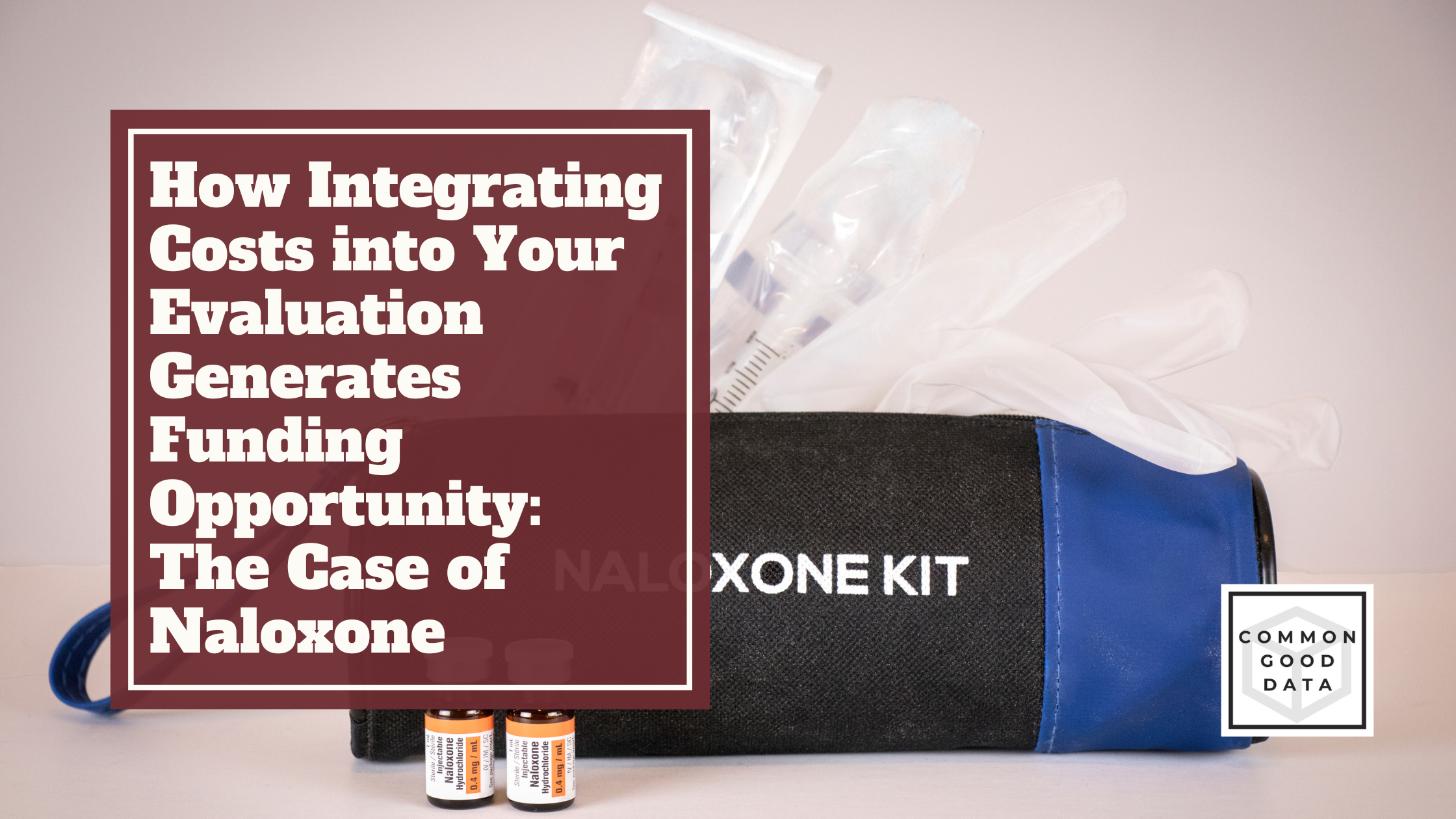
How Integrating Costs into Your Evaluation Generates Funding Opportunity: The Case of Naloxone
In public health evaluation, it is common to translate program outcomes into cost-effectiveness metrics. The goal is not to place a value on human life, but rather to illustrate how relatively modest investments in prevention can generate substantial, life-saving impact.
Consider a naloxone distribution program.
Imagine a program distributes 10,000 naloxone kits in a year. To make the math simple, assume each kit costs $50. That means the direct supply cost is:
Beyond Good Intentions: Protecting Funding Through Defensible Impact
Most behavioral health programs are doing meaningful work. They are serving individuals in crisis, coordinating care, building coalitions, and responding to evolving federal and state requirements. The commitment is real, and the impact on communities is significant.
Yet many program leaders quietly feel vulnerable as grant terms approach their end. Not because the work is weak, but because sustaining it often requires securing new funding. When a federal award sunsets, the question becomes whether the program can compete effectively for the next opportunity, whether from the same agency or a different source altogether.
How Do You Know If Your Program Is Actually Working?
I hear nonprofits tell me all the time, “I think our program is working. But I just don’t know how to show it!”
They weren’t alone. Many nonprofit and public-sector organizations are working incredibly hard, delivering services every day, and meeting urgent needs in their communities. And yet, when it comes time to answer a simple question of whether the organization has evidence that their program is working or not, the room gets quiet.
“We know it works. But I can’t give you any data to support that.”
This uncertainty isn’t a failure. But it is a sign it’s time for you organization to level up.

How to Simplify Your Metrics in 60 Minutes
You’ve experienced it. Too many metrics. Too many spreadsheets. Too many reports that take hours to produce. And minutes to skim.
And what do you get for it? Stress. And a team that feels overwhelmed, frustrated, and unsure which numbers actually matter or why they’re being collected in the first place.
The good news: simplifying your data doesn’t require a new system, a consultant, or a months-long strategic process.
You can make meaningful progress in about 60 minutes. Here’s how.
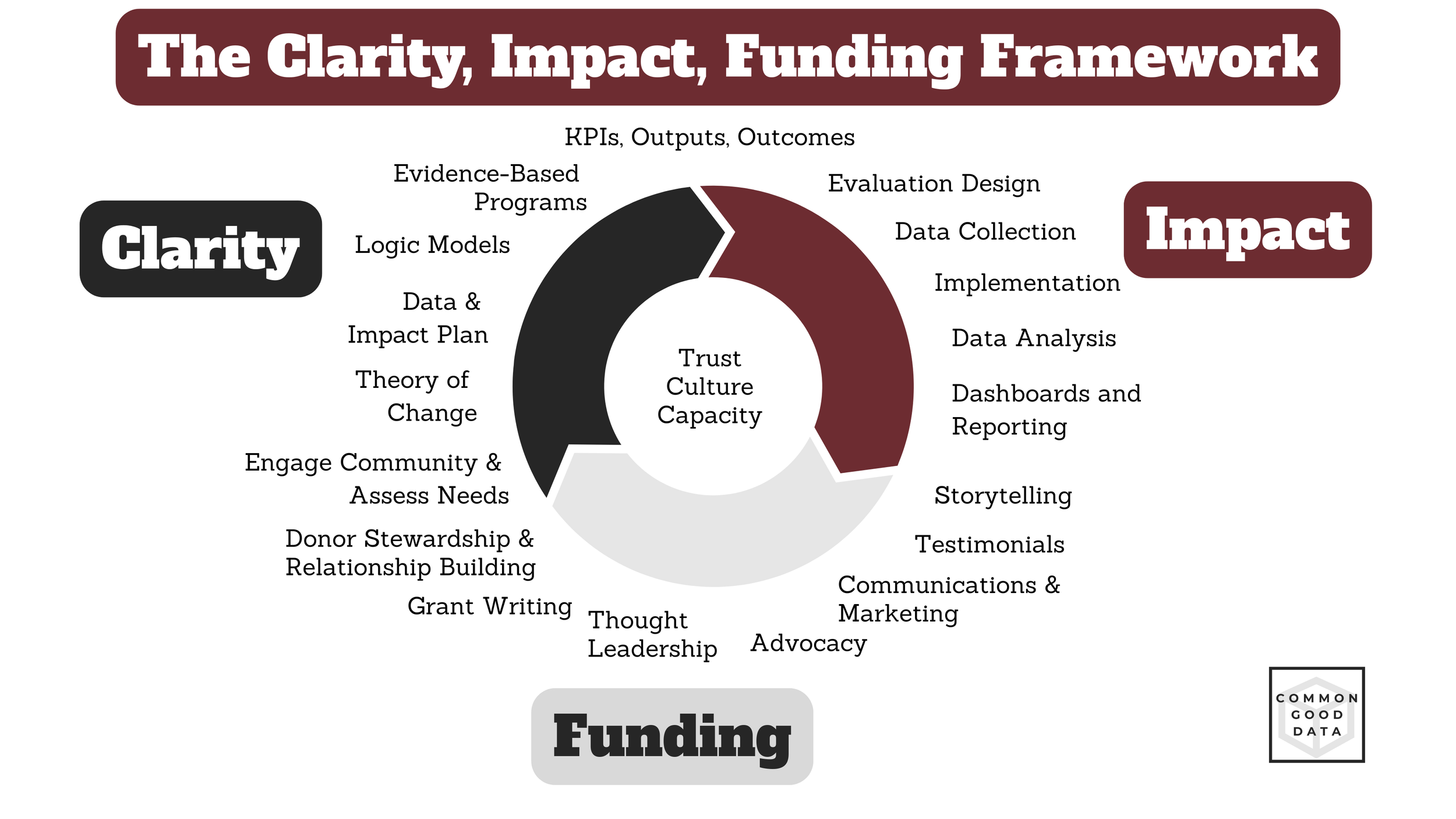
Three Steps to Thrive as a Nonprofit
Many nonprofit leaders know what it feels like to be constantly running on empty. The pressure to do more with less. The uncertainty of whether the next grant will come through. The feeling that your organization is always one budget cycle away from falling behind.
This reality is known as the nonprofit starvation cycle. It’s what happens when organizations focus so heavily on survival that they lose sight of strategy. It leads to burnout, limited capacity, and a constant sense of scarcity.
At Common Good Data, we believe the solution isn’t to work harder — it’s to work smarter. Thriving nonprofits are guided by three essential elements: Clarity, Impact, and Funding. Together, they form what we call the CIF Framework — a simple model that helps organizations grow with confidence and purpose.

Shutdowns, Delays, and Disruptions: How Nonprofits Can Use Data to Navigate Turbulent Times
The federal government is once again on the brink of a shutdown. For nonprofits and public agencies that rely on federal grants, contracts, or approvals, this brings familiar uncertainty: Will payments stall? Will grant reviews be delayed? Will already-thin staff be forced to do more with even less?
Will it last a day, a month, or longer?
In moments like these, it’s easy to hunker down and think only about survival. And yes—addressing immediate needs is critical. But organizations should resist the pull of near-termism. Shutdowns come and go. What matters most is positioning your organization to thrive not just tomorrow, but one, three, even five years from now.
Breaking the Starvation Cycle: Why Nonprofits Need Data Strategy
If you’ve ever felt like you’re stuck in a cycle of scrambling for funding, worrying about payroll, and trying to do more with less, you’re not alone. Many nonprofit and public sector leaders face the relentless pressure of what’s called the nonprofit starvation cycle. It’s the reality of being asked to deliver big impact with limited resources, often under the weight of funder expectations to keep “overhead” low. The result is a scarcity mindset that keeps organizations in survival mode rather than thriving.
The danger of a scarcity mindset is that it convinces leaders they can never invest in the very things that would strengthen their organization — staff, systems, and strategy. Every week feels urgent, and long-term planning feels out of reach.

Surviving the Squeeze: How Evaluation Helps Nonprofits Navigate Funding Cuts
Across the country, nonprofit and public sector organizations are facing the hard truth of reduced funding. Whether due to shifts in government priorities, economic slowdowns, or the winding down of pandemic-era investments, the result is the same: organizations are being asked to do more with less.
I was on a call with a public sector client recently who was sharing their concerns about funding cuts, and the potential for impact on their programs and services. They said [paraphrased], “We’ve been told the cuts are coming, and decisions are being made on what programs to keep. So we really need to get better at sharing our data and telling our story.”

Not Just a Report: How Strong Leaders Use Evaluation Data to Drive Impact
As fiscal years wrap up, many nonprofit, public health, and human service leaders find themselves staring at a thick stack of charts, graphs, and narrative summaries. The evaluation report is finished. The numbers are in. The funder deliverables are met.
Now what?
For too many organizations, that report becomes the end of the evaluation process. It gets submitted, filed, and rarely referenced again until the next grant cycle. But strong leaders—those who drive lasting change—use evaluation differently. For them, data isn’t a formality. It’s a leadership tool.
Here’s how those leaders turn evaluation reports into real impact.

How Focus Groups Can Inform Your Community Health Assessment
Community health assessments (CHAs) are essential tools for understanding the health needs, priorities, and assets within a community. When done well, CHAs do more than just catalog health statistics—they tell the story of the community’s lived experiences, challenges, and aspirations for wellbeing.
Focus groups offer one of the most powerful ways to bring those stories to life. They allow us to move beyond numbers and listen deeply to the voices of people who are most impacted by health disparities, access barriers, and systemic inequities. In this post, we will explore how focus groups can strengthen a community health assessment, drawing on real-world examples and highlighting additional qualitative methods you can use to amplify community voice.

Planning and Facilitating Effective Focus Groups
Focus groups can be a powerful way to elevate community voice, gather deep insight, and inform your programs with real-world context. When designed thoughtfully, they offer more than just opinions—they provide lived experience, nuance, and the "why" behind the data. In this post, we walk through best practices for designing and facilitating focus groups, from recruitment and consent to facilitation and follow-up. We also share tools that can help you do this work ethically, effectively, and with care.

How New Executive Orders May Impact Nonprofits: What You Need to Know
The first few weeks of 2025 have brought significant changes for many nonprofit organizations, particularly those engaged in Diversity, Equity, and Inclusion (DEI) initiatives, LGBTQ+ services, international aid, immigration, education, and health and human services. A series of new executive orders are reshaping federal funding priorities, compliance requirements, and eligibility for a broad array of programs critical to nonprofits.
For many nonprofits, this has created uncertainty about the future of their work, funding, and partnerships. In this post, we’ll break down some of the key executive orders impacting the nonprofit sector, discuss potential challenges, and explore practical steps organizations can take to navigate these changes.

6 Data Sources to Power Your Community Needs Assessment—No Survey Required
Conducting a community needs assessment can feel like a massive undertaking. Thankfully, you don’t need to reinvent the wheel—or conduct an expensive survey—to get the insights you need.
Many powerful data sources are readily available to help you identify gaps, understand risks, and develop targeted solutions for your community.
In this post, we’ll explore six data sources that can help you complete your needs assessment efficiently.
How to Build a Strong Data Culture in Your Nonprofit–and Why it Matters
A challenging mindset in the nonprofit sector is the perception that any investment in organizational capacity is a cost. This perspective isn’t limited to nonprofit leaders; it’s also held by funders, donors, and contributors.
Many fundraising strategies aim to exclude overhead expenses, a practice that contrasts with how public and private sector organizations justify similar expenditures. Nonprofit leaders have internalized this mindset, leading to the belief that spending on internal capacity is detrimental. This misconception suggests that such investments are wasteful rather than strategic.
However, it's important to recognize that while many nonprofits operate with tight budgets, strategic investments can yield significant long-term benefits. These investments go beyond financial savings. They improve decision-making and save valuable time—our most crucial resource as leaders.

The Importance of Data in Nonprofit & Social Sector Work — cityCURRENT Interview
Drew sat down with CityCURRENT show host, Jeremy C. Park, to chat about his journey from academia to launching his own company, all while helping nonprofits and public sector organizations make a real impact through data.
During the conversation, Drew breaks down how nonprofits can use data to measure their impact, make better decisions, and improve outcomes for the communities they serve.
He shares his approach to building a “Culture of Data,” how to make data more accessible, and why it’s important for leadership to model data-driven practices. He also reflects on how this work fuels his own professional growth, while offering practical tips on using data for advocacy and strategic planning.
New Data on Economic Mobility in Atlanta and Charlotte: What Has Changed?
When we think about the American Dream—the idea that anyone can succeed if they work hard—it’s really about economic mobility.
Economic mobility is about the chances someone has to move up (or down) the economic ladder compared to their parents. If a child grows up in poverty but later earns enough to be considered middle class, that's economic mobility in action. On the other hand, if a child starts off in a middle-class family and falls into poverty as an adult, that's downward mobility.
The Changing Opportunity study, published by the Opportunity Insights team led by Harvard’s Raj Chetty in 2024, examines this issue. It adds new data and expands on findings from the original 2014 study.

Designing Effective Youth Substance Use Surveys: A Case Study from Charlotte, NC
Youth substance use is a complex and evolving issue that presents significant challenges for communities across the United States. In Charlotte, NC, the Center for Prevention Services (CPS) has been at the forefront of addressing this issue through data-driven approaches.
One of their most powerful tools has been the Youth Drug Survey (YDS), a survey tool for understanding substance use patterns among youth and shaping prevention strategies. This blog post shares CPS’s experience in designing and refining the YDS offers valuable lessons for creating effective youth substance use surveys.

The Eval Section - Part #3: Data Analysis for Grant Proposals
For our third installment of the four-part blog series to help de-mystify the world of data and program evaluation in federal grant proposals, our focus is on articulating your approach to data analysis—both quantitative and qualitative—in your grant proposals in the areas of human services, behavioral health, youth services, education, and housing. Topics include:
Meeting grant requirements
Defining objectives for your data analysis
Analysis: Quantitative data
Analysis: Qualitative data